
Dial In Your Dedica Espresso: Grind Size, Dose, Shot Time
Three numbers and one rule: change only one thing at a time. For the Dedica with a non-pressurised basket and your own grinder.
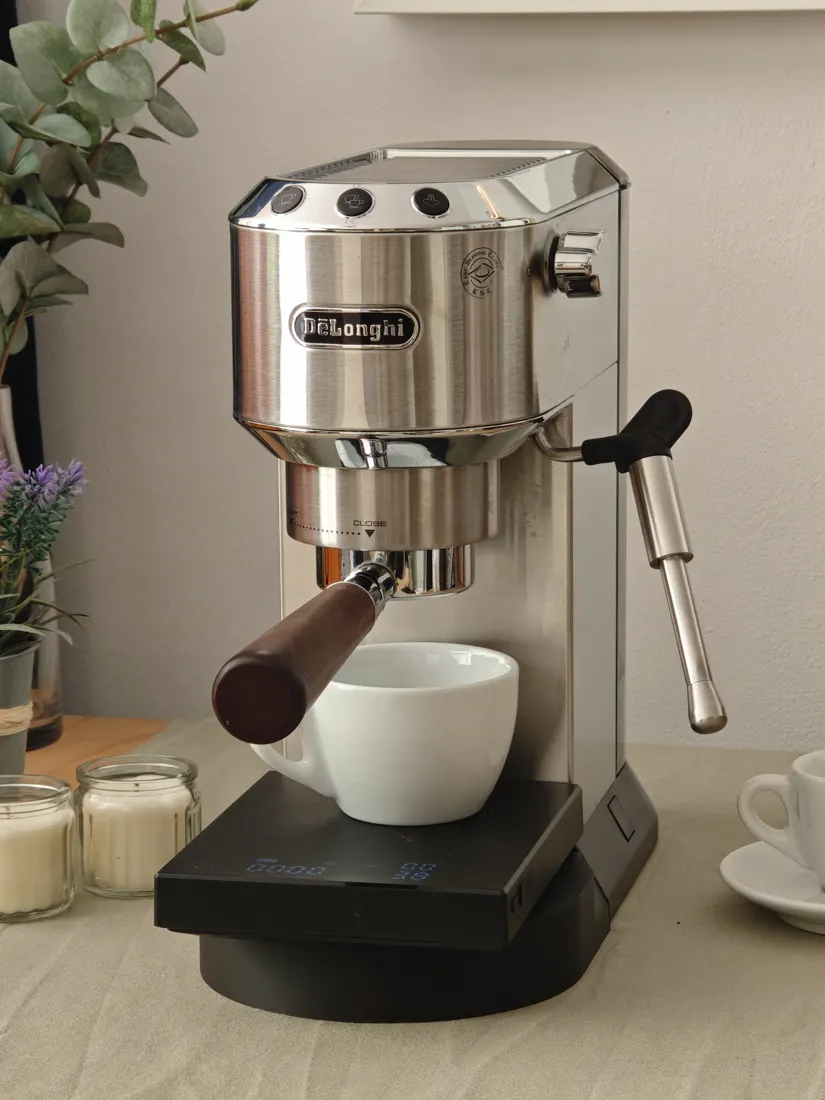
1. The Dedica espresso recipe
Starting point: 16 g in, 32 g out, 25 to 30 seconds
What is it for?
What counts is the ratio, usually 1:2[4][8]: a given amount of ground coffee turns into about twice that amount of coffee in the cup. If dose, yield and time are right, it tastes good. If one is off, you know what to adjust.
Rule of thumb: Twice as much in the cup as in the basket. Time starts when you press the button, not at the first drop.[5]
What you need
- A non-pressurised 51 mm basket. In the stock basket, the basket does the braking, not your coffee.[7] More on that: Non-pressurised basket.
- A grinder that grinds fine enough for espresso. Pre-ground coffee is usually too coarse.
- A scale accurate to 0.1 g that fits under the spout together with a cup. More on that: Room under the spout.
- Fresh beans: from two to three weeks after the roast date, no older than three to four months.[12]
| Basket | Dose | In the cup | Time |
|---|---|---|---|
| 25 mm deep (black insert out)[6] | 16 g | 32 g | 25 to 30 s |
| 20 mm deep (usually fits without modification)[6] | 12 to 13 g | 24 to 26 g | 25 to 30 s |
By weight, not millilitres: crema is foam made of gas bubbles and fools you in the glass. On the scale it hardly counts.
2. How to make espresso on the Dedica, step by step
Do it the same way every time. Only then does the scale tell you whether a change was worth it.
Prepare
- Switch on. Wait until the lights stop flashing.
- Lock in the portafilter with an empty basket, cup underneath.
- Press 1 cup. The hot water preheats the portafilter and cup.[1]
- Remove the portafilter, wipe the basket dry.
- Run 2 cups twice without the portafilter. When the pump pauses (), press again. That leaves you about a minute to grind.[11]
This keeps the temperature at about 92 °C. Without preheating it drops to about 88 °C towards the end.[9]
Grind and tamp
- Weigh 16 g of beans, grind, into the basket.
- Stir the grounds with a needle or tap the portafilter briefly on the counter until they're level. No clumps, no dip.
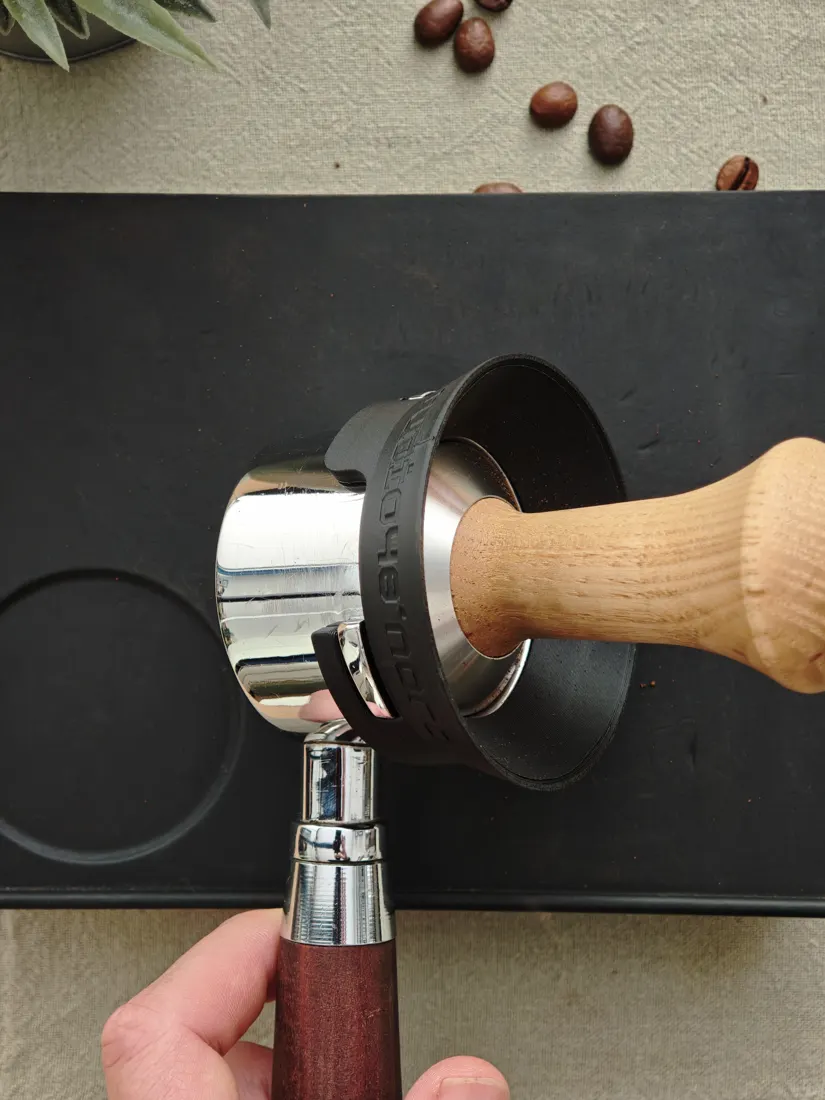
- Tamp level, about 10 kg.[4] More makes no measurable difference[3]; much less and the espresso runs faster.[1]
- Wipe the basket rim clean.
A test series with 10, 15 and 20 kg shows no significant difference in time or .[3] Level matters more than force.
Pull the shot
- Lock the portafilter in as far as it goes, holding the machine with your other hand. It's light and slides along otherwise.[11]
- Scale underneath, cup on top, tare to zero.
- Press 2 cups and count the seconds.
- Just before 32 g, press the button again.[1] Up to 4 g more will still come through. Stop at 14 g and you end up with up to 18 g in the cup.[9]
For 32 g from 16 g, use the 2 cups button. Out of the box it delivers 70 ml[1], so stop it by hand or save the water amount to the button, with a scale underneath.
For the first 4 to 5 seconds it only drips, then the pump pauses briefly. That's the fixed pre-infusion, not a fault. You can't switch it off.[10]
Afterwards
- Leave the portafilter in for about a minute, then the basket sticks less often.[△] More on that: Basket stuck in the machine.
- Twist it out slowly, or it sprays: there's still pressure on the basket afterwards.[9]
- Knock out the puck, rinse the portafilter, run some water without the portafilter. More on that: Dedica cleaning.
3. Dialling in: change one thing at a time
Dose and yield stay fixed. Grind size controls the time. Only once the time is right do you work on taste.
Dedica grind size
What is it for?
Grind size determines how much resistance the water meets. Finer means slower and stronger, coarser means faster and thinner. It's the lever for shot time.
Rule of thumb: Too fast: finer. Too slow: coarser. After every change, grind a few grams through, or old grounds are still sitting in the grinder.
How do I set it?
- Pull a shot following the recipe, note time and weight.
- Faster than 25 seconds: grinder one small step finer. Slower than 30: one step coarser. Way off: a bigger step.
- Pull another, with the same dose and the same yield.
- Repeat until 32 g come out in 25 to 30 seconds.
New beans, new grind size. Even the same coffee changes over the weeks; usually you then have to grind finer.
Dose: how many grams in the basket
What is it for?
The dose is how much ground coffee sits in the basket. It depends on the basket, not on taste. Too much and the portafilter is hard to lock in or the coffee touches the shower screen. Too little and the water finds channels.
Rule of thumb: Set it once to suit the basket, then leave it alone. Always weigh: one gram more takes about 4 seconds longer.[4] I've never fitted more than 16 g into my 51 mm baskets.[△] A Sage basket in the modified stock portafilter takes 18 g.[11]
How do I find it?
- Fill the basket, tamp, lock in the portafilter, don't press any button.
- Take it out again and look at the coffee.
- Imprint on top of the coffee: 0.5 g less.[△]
- No imprint, and the portafilter went in easily: the dose is right.
Yield in the cup: 1:2 ratio
What is it for?
The yield is how you adjust taste once the time is right. Shorter gets thicker and sweeter but can tip into sour. Longer gets clearer and lighter but can turn bitter.
Rule of thumb: Stay at 1:2 until the time is right. Then try steps of 2 to 3 g.
How do I set it?
- Tastes sour or sharp: let it run 2 to 3 g longer.
- Tastes bitter or dry: 2 to 3 g shorter.
- Tastes thin: check the grind size first, then shorter.
- Right: save the amount to the button. The Dedica then hits it to within 1 to 1.5 g.[10] More on that: Set the water amount.
Temperature
What is it for?
The Dedica has three settings. Too hot makes dark roasts bitter, too cool makes light roasts sour. Temperature comes last.
Rule of thumb: Dark roast low, otherwise medium. High almost never, at most for a very light roast.[9]
How do I set it?
- Recipe and grind size are right, only the taste isn't quite there yet.
- Change the setting.[1] More on that: Set the temperature.
- Make the same espresso again, only the setting is different.
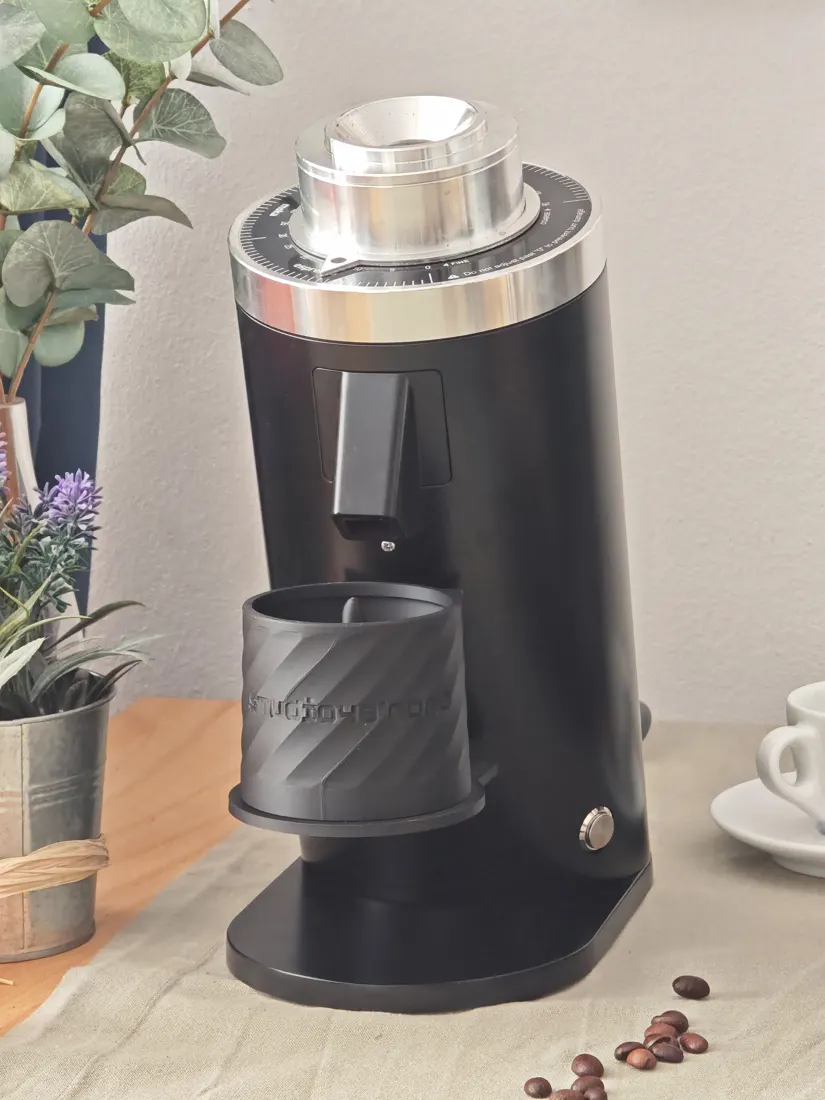
16 g in, 32 g out, and my DF64 is set very fine: fine enough that the 32 g only just come out in 25 to 30 seconds. I'm deliberately not giving the number on the dial: it changes with every coffee and even with the age of the beans. Beans will get their own article. For decaf, the Sage Smart Grinder Pro does the job.
The grounds go from the blind shaker into the basket, and sometimes I stir them with the WDT needle. With the needle there are no clumps left, which looks nicer. Honestly, I barely taste a difference in the cup if the tamp is decent. I tamp with a 51 mm metal tamper. Tamping too lightly happens easily, too hard hardly ever, as long as you don't go completely overboard. That's my experience, but it matches the test series above.[3]
I'd like to put more in, but 16 g is the limit for my baskets. I've saved the amount to the 2 cups button. I only need the scale under the cup now when new beans arrive. I always weigh the beans. Temperature on level 1, because it's a dark roast, and water from the Brita filter.
In the photo: DF64 grinder, Blindshaker 51 mm, DF64 Blindshaker Holder
4. Espresso too fast, only dripping, sour or bitter
| You notice | Likely cause | What to do |
|---|---|---|
| runs through in 10 to 15 seconds, pale crema | too coarse, too little coffee, tamped too lightly or beans too old[12] | grind finer, check dose and tamp. If it won't slow down on the finest setting: the grinder doesn't grind fine enough for espresso. |
| only drips, over 40 seconds | too fine, too much coffee, basket blocked or limescale | grind coarser, use less if there's an imprint in the coffee, otherwise clean the basket or descale |
| bottomless portafilter sprays, single jets | : water finds its own paths | distribute the coffee better, tamp level, check the grind size |
| portafilter hard to lock in | too much coffee | 0.5 g less |
| sour, sharp | too coarse or too short | too fast? finer. Time right? 2 to 3 g longer |
| bitter, dry | too fine or too long | too slow? coarser. Time right? 2 to 3 g shorter |
| every shot different, same settings | dose varies or grinder not purged | weigh every dose, grind a few grams through after adjusting |
| button suddenly gives more or less | grind size or dose changed[10][11] | weigh the dose; after a big grind change, save the amount again |
| hardly any crema | old beans | buy fresher, check the roast date |
Lights, pump, descaling: Troubleshooting in the descaling guide.
New beans, old grind setting: runs through in 15 seconds. Grinder adjusted but not purged: the first espresso is still the old one. Dosed by eye: one gram off, and the time is wrong. It's almost always one of these.
Frequently asked questions
How much coffee goes in the Dedica basket?
With a 25 mm deep non-pressurised basket about 16 g, with the 20 mm deep one about 12 to 13 g. I've never fitted more than 16 g into any of my 51 mm baskets. A Sage basket in the modified stock portafilter takes 18 g. The dose depends on the basket, not on taste. Always weigh it. More on this: Dose.
How long should a Dedica espresso shot take?
About 25 to 30 seconds from pressing the button for twice the dose in the cup, so 32 g from 16 g. If it runs much faster, grind finer. If it runs much slower, coarser. More on this: The recipe.
What grind size do I need for the Dedica?
There's no fixed number, every grinder and every bean is different. Set the grind so that 32 g come out of 16 g in 25 to 30 seconds. After every change, grind a few grams through, or there's still old coffee in the grinder. More on this: Grind size.
Which scale fits under the Dedica?
A slim scale around 15 mm tall, for example the Acaia Lunar (per the manufacturer) or the Bookoo Themis Mini (per the retailer). Whether scale and cup fit underneath together depends on the portafilter and drip grid. More on this: Room under the spout.
Do I need a scale for the Dedica?
Yes, if you use a non-pressurised basket. By weight, every espresso is repeatable. Millilitres are misleading because crema is mostly gas bubbles. More on this: The recipe.
My Dedica espresso runs too fast, what now?
Grind finer. If it runs through in 10 to 15 seconds and the crema is pale, the grind is too coarse, there's too little coffee in the basket or the beans are too old. Check the dose, then set the grind finer in small steps. If it won't slow down on the finest setting, the grinder doesn't grind fine enough for espresso. More on this: Troubleshooting.
My Dedica espresso only drips, what now?
Grind coarser. If the coffee shows an imprint on top after locking in, there's also too much in the basket: 0.5 g less. More on this: Troubleshooting.
How hard should I tamp on the Dedica?
Level, with about 10 kg. A test series with 10, 15 and 20 kg shows no significant difference in time or extraction. Much less, and the espresso runs faster. More important is that the coffee is evenly distributed first. More on this: Making espresso.
Why does my bottomless portafilter spray on the Dedica?
The water forces individual paths through the coffee (channeling). Distribute the coffee before tamping, tamp level. If it runs too fast, grind finer. More on this: Troubleshooting.
Can the Dedica stop at 32 g by itself?
Not by weight, but by water amount. With a scale under the cup, press and hold the button and release it at the right amount; it then stops there every time. Check briefly after a grind change. More on this: Yield in the cup.
My Dedica espresso tastes sour, what now?
Check the time first: if it runs too fast, grind finer. If the time is right, let it run 2 to 3 g longer. If neither helps and the roast is light: temperature to medium (level 2), if it's still on low. Level 3 (high) is worth it at most for very light roasts. More on this: Yield in the cup.
My Dedica espresso tastes bitter, what now?
If it runs too slowly, grind coarser. If the time is right, 2 to 3 g shorter. With a dark roast, set the temperature to the low setting. More on this: Yield in the cup.
Sources
Numbers and operating steps carry a small number in the text. Click it to jump to the source.
- De'Longhi, Dedica EC685/EC695/EC785 instruction manual (PDF, in German), German edition 06/2026: preheating, programming the amount, factory water amounts, stopping delivery, troubleshooting.
- De'Longhi, Instructions Dedica EC885 (PDF, US edition), 04/2025: same buttons, water amounts and menus as the EC685.
- Kaffeemacher, Tamping pressure, 2025: test series with 10, 15 and 20 kg, 50 shots each, no significant difference.
- Kaffeemacher, How to make espresso, 2026: brew ratio 1:2 to 1:2.5, dose for the Dedica 14 to 16 g, 25 to 30 seconds from pressing the button, one gram more extends the shot by about 4 seconds, tamp with about 10 kg.
- Kaffeemacher, Espresso extraction time, 2026: the time starts as soon as the machine delivers water.
- Kaffeemacher, 51 mm baskets (product page, in German): 20 mm deep 12.5 g, 25 mm deep 16 g, with the 25 mm basket the black insert has to come out.
- Kaffeemacher, Article on the De'Longhi Dedica EC685, 2021: stock baskets are double-walled, empty shot to preheat.
- Specialty Coffee Association, Defining Ever-Changing Espresso (25 Magazine, Issue 3), 2018: survey of 275 baristas, average 1:2, mostly 25 to 30 seconds.
- Kaffeemacher (YouTube), “So machst du guten Espresso mit der Delonghi Dedica [Reihe 3/5]” (in German), 2023: brew temperature with and without preheating (92 vs 88 °C), run-on after stopping, residual pressure when removing the portafilter, recommendation on the temperature settings.
- Kaffeemacher (YouTube), “Delonghi Dedica 685 vs 885 - Espressomaschinen-Vergleich [Dedica Reihe 1/5]” (in German), 2023: fixed pre-infusion, deviation of the saved amount over 10 to 15 shots, more deviation after a grind change.
- Kaffeemacher (YouTube), “Delonghi Dedica EC685 - die populärste Start-Espressomaschine - Test” (in German), 2022: preheating with two pre-infusions, holding the machine when locking in, Sage basket with 18 g in the modified portafilter.
- Kaffeemacher (YouTube), “Fake-Siebe: Wir verstehen sie, aber sie lösen das falsche Problem” (in German), 2026: age of the beans, grinder not grinding fine enough.
- My own experience, Max Fraunhofer, Dedica EC685 in daily use for years. Marked as “How I do it”.

You can get my parts here in the shop and on Etsy.